Finessing fried pies
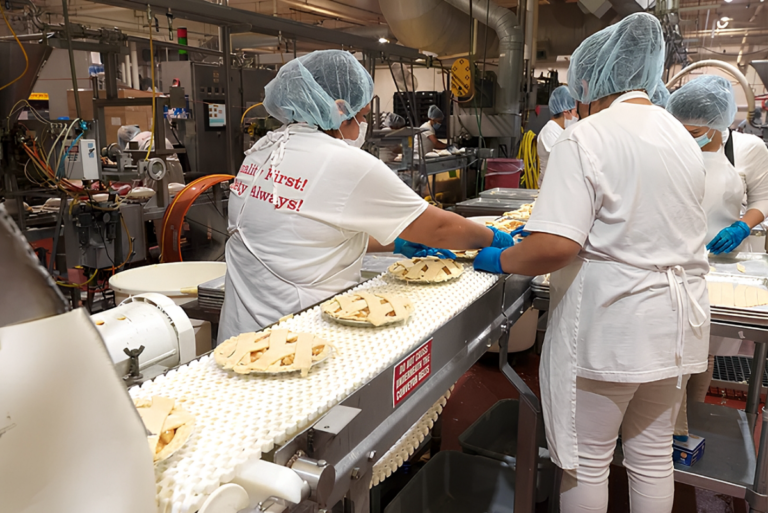
The fried pie production is mostly automated, with industrial mixers used to process 1,000 pounds of dough per batch. The mixed dough is deposited on the sheeting line, where top and bottom dough sheets are made. Fillings are cooked in kettles, cooled using large votators, and piped or spot-deposited onto the bottom dough sheet with the other sheet placed on top.
Pies are crimped, cut into rectangles and placed directly into the spiral freezer. When frozen, they are run through a glaze waterfall, which creates a bubble-like texture on the surface. That way, when the pies are fried, they remain crispy without too much oil seeping into the dough.
“We tried frying without the glaze, but the pies were too greasy,” Fletcher said. “The glaze helps create a quality end product that we can stand behind.”
Lone Star uses a standard dough for its individual pies, and the special glaze is added to all unbaked pies, regardless of flavor. The fillings are where Lone Star gets creative.
“Developing new flavor profiles for our customers can require extensive collaboration and coordination,” Fletcher explained. “Sometimes a customer’s idea for a new flavor is more challenging to implement, and a test run must be conducted to ensure the filling pumps work with the formula.”
Fletcher described a particularly challenging cookie dough filling. By the time the filling was ready to run on the line, it was too viscous to run through the filling pumps. The ingredients had to be reformulated several times before operations could get the product to run smoothly.
Savory fillings can also be tricky to machine.
“We actually created a savory chicken pot pie for a customer that was sold as a limited-time offering,” Fletcher said. “The main challenge with savory fillings is that particulates within the mixture must be uniform and not too large to pump through filling pipes.”
Currently, Lone Star’s frozen fried pies are manually packed into trays and shrinkwrapped for cold storage. Fletcher is exploring evolving innovation and could potentially acquire new, more cost-effective packaging equipment.
To preserve peak freshness and quality, Minneapolis-based Rise Baking also ships its pies frozen to lock in flavor and texture from the moment they leave the production facilities.
“Post-shipping, we offer multiple formats, including ready-to-bake and retail-ready options that fit a variety of operational needs, designed to make things easier for our customers,” said Mike Docherty, EVP, marketing, R&D and innovation at Rise Baking.
Understanding a customer’s operational needs is integral for pie manufacturers. To this end, Salt Lake City-based Rocky Mountain Pies works to develop product solutions to minimize labor, improve quality and simplify jobs for its customers. For example, its par-baked fruit pie program doesn’t require customers like foodservice operators or in-store bakeries to have a professional baker on-site to properly prepare pies.
Additionally, Rocky Mountain worked with D&W Fine Pack to create new half-pie tins and packaging.
“We retooled our pie machine to produce the new half pies, which helps our customers reduce in-store labor and packaging costs by offering a half pie, sealed and ready for sale,” Grandinetti explained.