

Advertisement

Solving the ‘protein predicament’

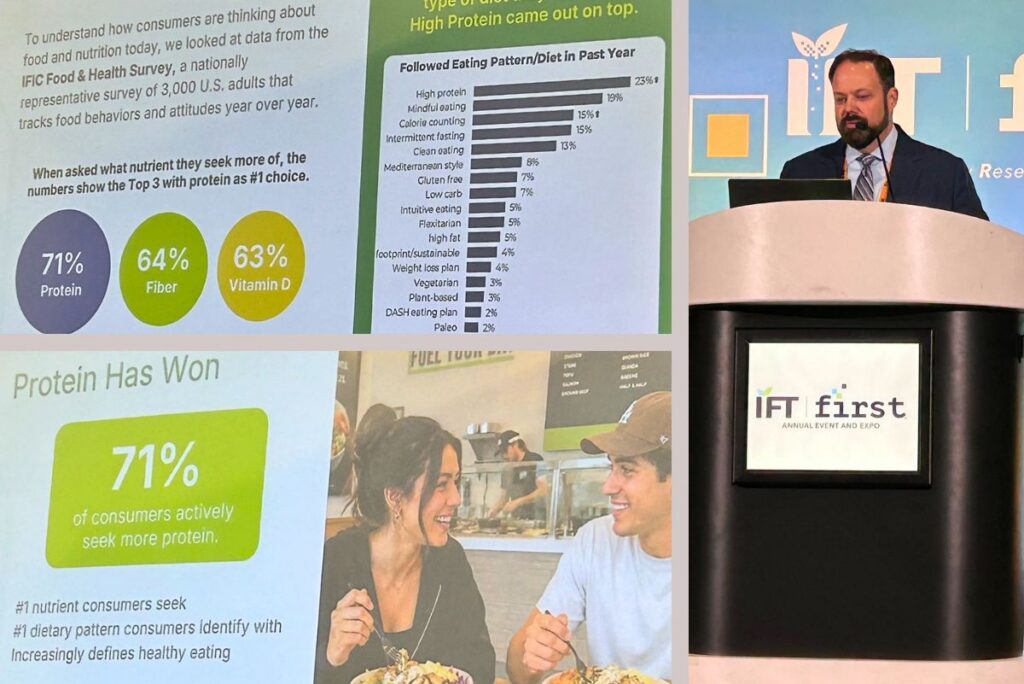
Collage of presentation from IFT FIRST 2026 on the protein predicament, including speaker Justin Shimek
GRAPHIC COLLAGE BY AVANT FOOD MEDIA
BY: Mari Rydings

Mari Rydings

CHICAGO — From Doritos to donuts to pastries, protein is everywhere in the commercial baking industry, and it’s enjoying a long run as consumers’ favorite nutrient. Yet, despite protein’s popularity, there remains a knowledge gap about what it is, the benefits it can provide and how much people actually need.

Justin Shimek, chair and CEO of Mattson, a food and beverage innovation company, labeled this gap the “protein predicament” during his presentation at the Institute of Food Technologists (IFT)’s annual IFT FIRST event, held July 12-15 in Chicago.

“Consumers are actively looking for protein, and brands are putting it everywhere,” he said. “Retailers are putting incredible amounts of shelf space to it. Everyone agrees that protein is so important. Yet, consumers are struggling to really understand it on a deeper level. Awareness of and desire for protein have scaled much faster than actual knowledge.”


Advertisement

To get a better understanding of what consumers know about — and what they want from — protein, Mattson initiated a multi-modal study that included a sizeable quantitative study and qualitative one-on-one interviews with real people. The goal of the study was to find answers to questions such as: What does protein mean to consumers? Where are they confused? What are some of the barriers that remain? What are the opportunities that exist for innovation and communication?

“The intent was to segment out the motivations, needs and behaviors of consumers around protein,” Shimek said.

Study results revealed consumers are:

  • Seeking practical and affordable protein
  • Focused on protein’s role in healthy aging
  • Interested in optimizing athletic performance through protein
  • Consuming protein as a way to maintain muscle mass.

“Through our research, we found consumers are incredibly committed to eating more protein,” he added. “But when we asked them directly how much protein they actually needed, they couldn’t tell us, and they had low confidence in understanding their protein needs or defining their protein goals.”

“Consumers are incredibly committed to eating more protein, but when we asked them directly how much protein they actually needed, they couldn’t tell us, and they had low confidence in understanding their protein needs or defining their protein goals.” — Justin Shimek | chair and CEO | Mattson

Advertisement

Shimek said this was an opportunity to improve brand-to-consumer conversations and education around how much protein a person needs and its benefits.

“Part of our role is to figure out how to more adequately communicate protein needs and help simplify the experience,” he said. “We found that 74 percent of people aren’t actively tracking their protein intake. For 55 percent of people, their strategy is to try and include protein in every meal. They are looking for sources that makes them feel good or full. They aren’t necessarily seeking a number or counting grams.”

Beyond that, Shimek identified several market opportunities for product innovators, all carrying the caveat that one solution doesn’t fit all consumers.

Advertisement

“Think about who you’re designing for,” he said. “For consumers who take GLP-1 medications, it’s about smaller eating occasions and nutritional density. For active women experiencing menopause, protein density is important. Design protein products for life stages.”

For food manufacturers looking to solve the protein predicament by narrowing the knowledge gap around protein, simple messaging that builds consumer confidence and makes understanding protein easier and more convenient could be the clearest path.

Related News

Advertisement

Advertisement

Advertisement

Advertisement

Popular Articles