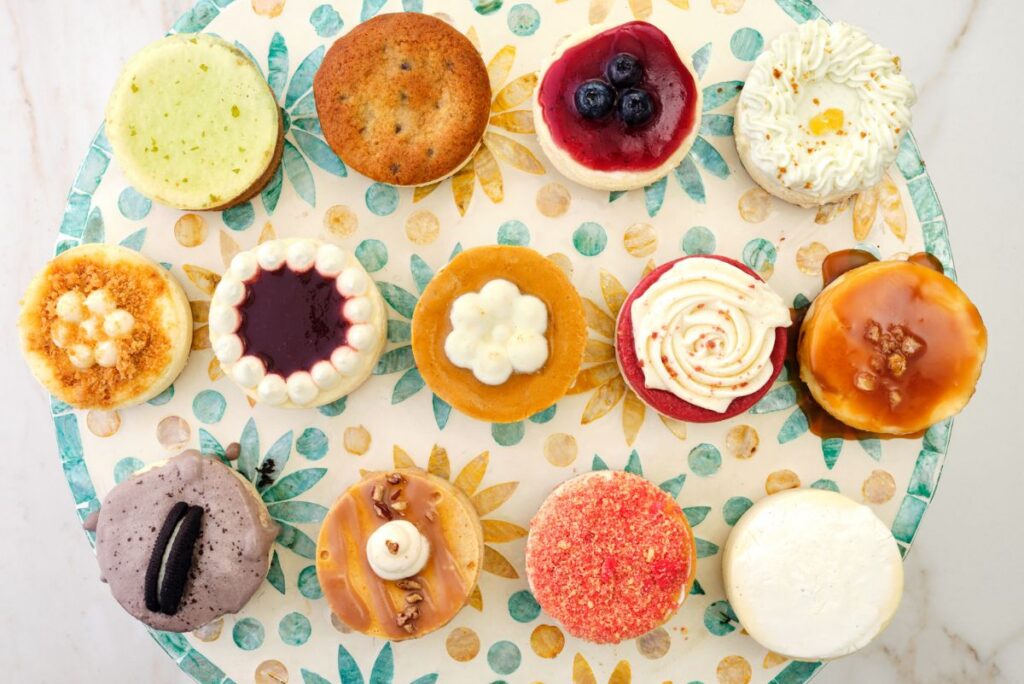
While he was bartending at Grace’s Mandarin, a high-end Asian-fusion establishment in Baltimore’s National Harbor, management allowed him to have a dessert menu insert. It was an opportunity to not only test the product but also make formula adjustments based on immediate feedback.
“This opportunity allowed me to engage directly with customers, see what they responded to and understand what didn’t land,” he recalled. “I was able to more or less survey the customer base at Grace’s, and I was constantly getting ideas that I could test almost immediately. Then I could do some research and come back to the shared kitchen to learn the skills I needed to upgrade the product and continue that early R&D.”
Building a brand
For any emerging brand, networking is the centrifuge for opportunity, and Branden Wiles, Hiatus’ COO, spun a network that solidified the company’s reputation in the upper echelon of Baltimore’s foodservice scene, including not only the Preakness Stakes but also the notable Atlas Group, which owns some of the area’s top dining establishments.
“Networks become community for a business,” Wiles said. “When you create community, you gain support. And when you have that, opportunities inevitably come from it. Our relationship with Atlas Group was a direct result of the community we created.”
Local networking can be a tricky proposition. Just as product refinements are made with intention, so are Wiles’ networking efforts. Through a relationship with Cureate, a Baltimore-based non-profit aimed at helping small and marginalized businesses create pathways into the food and beverage supply chain, Hiatus landed contracts with local hospital cafes to sell packaged, branded carryout products. From there, it landed distribution contracts for more foodservice accounts and caught the attention of retailers like Whole Foods Market and Kroger. Ultimately, the business model — and product development strategy — had to make a seismic shift.
A plated experience comes with a totally different set of criteria than a packaged one, but the brand expectations remain the same. That opened the door to what Featherstone called the “second wave” of R&D … and where the CPG journey truly began.
“We focus on density, mouthfeel and flavor in a very deliberate way,” Featherstone said. “Balancing those attributes is critical for a cheesecake to be rich but not heavy, and indulgent but not overwhelming. That’s what makes it versatile enough to be plated in a restaurant, sold by the slice or eaten straight from the package at home.”
This story has been adapted from the April | Q2 2026 issue of Commercial Baking. Read the full story in the digital edition here.