


Advertisement

What’s really driving sustainable packaging innovation?

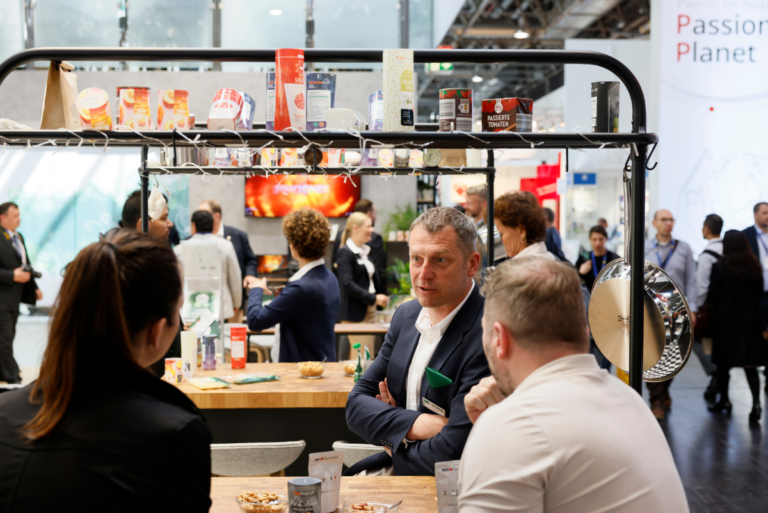
Panelists speaking about sustainability at interpack 2026 in Dusseldorf, Germany
GRAPHIC COLLAGE BY AVANT FOOD MEDIA
BY: Joanie Spencer

Joanie Spencer

DUSSELDORF, GERMANY — From ethos to regulation, food manufacturers around the world have a bevy of reasons to discover sustainable packaging solutions.

During interpack, held May 7-13 in Dusseldorf, Germany, a panel of packaging experts discussed overall packaging implications in the supply chain, including what’s driving sustainability innovation.

Panelists included Cyrille Filott, global head of consumer at Rabobank; Felix Bischopink, CEO of Packiro; and Ingo Meierhans, CEO of RheinNatur Food, with the conversation moderated by Paul Jenkins, CEO of The Pack Hub.

Jenkins recalled that when The Pack Hub began tracking packaging innovation a decade ago, a little less than half of the innovation related to sustainability. Today, he said, it looks more like 95%.

“Sustainability equals packaging innovation,” he said.
Advertisement

But the panel contended there’s more to it than that, especially amid economic pressures and European regulation looming just months away from compliance.

In fact, Filott noted that with financial constraints attached to EU’s Packaging and Packaging Waste Regulation (PPWR), many companies will have to focus most of their investments around PPWR compliance.

“I’m not saying that’s right or wrong, but it’s just a fact of life,” he said. “Economics matter.”

Bringing the co-packer’s perspective, Meierhans also emphasized cost as a primary driver for innovation, followed by speed to market.

“Unfortunately for now, sustainability looks more like third prize,” he said. “Perhaps this is not representative of all co-packers. But we often say to our customers, ‘There are [sustainable] options,’ and the question is always, ‘What does it cost?’ Pricing often determines why we have to just go with the standard. I wish it was different.”

“Sustainability equals packaging innovation.” — Paul Jenkins | CEO | The Pack Hub

Advertisement

For Bischopink, sustainability looks more like the tip of an iceberg driving bigger changes.

As change — from consumer trends to regulatory affairs — is happening faster than at any other time in history, flexibility must remain central to innovation.

“Having recyclable plastic might be nice for the moment, but I would say it’s only one quarter of a circular economy,” Bischopink said. “We have to consider that soon we have to use recycled plastic applications and find good solutions for paper as well. We have to be flexible in order to find good solutions.”

In the end, regardless of regulation, cost or a company’s values, the consumer ultimately decides sustainability’s value.

Advertisement

“When consumers walk into a store, every product is fighting for their arguments for why someone should choose it,” Bischopink said. “Sustainability is an honorable argument to choose. There are a lot of trends coming up where sustainable packaging can be a key differentiator on the shelf.”

But is it enough?

“The question remains, are consumers willing to pay more for a differentiated products with more sustainable packaging?” Filott suggested. “That remains to be seen.”

As PPWR impacts EU bakery producers, and state-specific extended producer responsibility legislation for consumer packaging hits US bakeries, the real driver for innovation may well lie in the small space that crosses over cost, regulation and consumer choice.

Related News

Advertisement

Advertisement

Advertisement

Advertisement

Popular Articles