
Advertisement

Automation leads to diversification for Lone Star Bakery

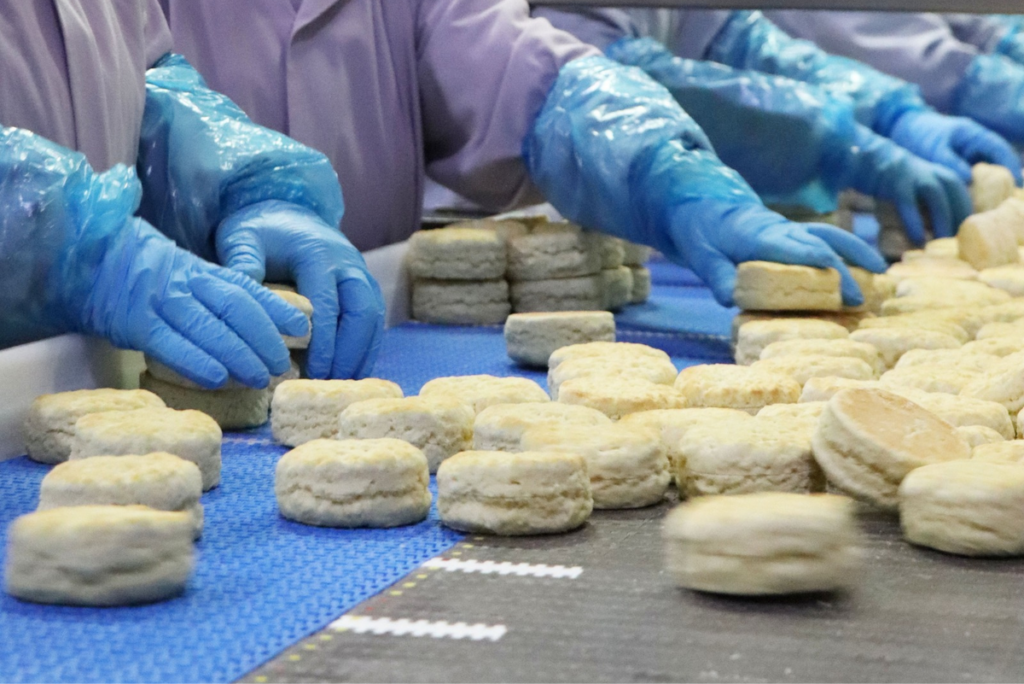
Lone Star Bakery employees placing biscuits on production line
PHOTO BY OLIVIA SIDDALL | AVANT FOOD MEDIA
BY: Mari Rydings

Mari Rydings

KANSAS CITY, MO — As the saying goes, “Everything’s bigger in Texas.” Need proof? Look no further than Lone Star Bakery. The San Antonio-based frozen baked goods manufacturer operates two 200,000-square-foot facilities — Plant 1 and Plant 2 — within a mile of each other, serving a customer base as varied as the products that roll off the lines. As if that’s not big enough, Lone Star is focused on growing even more.

To appreciate the magnitude of Lone Star’s business, it’s important to understand how it started: in 1889 as a small retail bakery with a local reputation for its fresh bread. When Mac Morris Sr. purchased the bakery in the ’50s, he remained committed to upholding its traditional values and producing the same high-quality bread while expanding distribution.

By the mid-’80s, Lone Star was under the leadership of Mac Morris Jr., who recognized that fresh bread alone could no longer sustain the business. With the evolution of freezing technology,
he saw an opportunity to transition production from fresh to frozen, starting with muffins for Shoney’s restaurants, eventually expanding to frozen biscuits for other customers.

As business picked up, Lone Star built Plant 1 to accommodate the volume. It’s been expanded several times over the years, and now produces biscuits, cake, cinnamon rolls, and frozen dough and has kosher and halal capabilities. Plant 2, which opened in the early 2000s, is USDA-certified and manufactures meat-filled products such as kolaches and pot pies along with fried hand pies, potato waffles, brownies and individual cup desserts.

The Lone Star customer portfolio includes some of the best-known brands in QSR, foodservice and casual dining, along with in-store bakeries and delis. Its sales regions cover the US, Canada, Latin America, New Zealand and the Philippines. Frozen biscuits and fried hand pies generate the bulk of business, with frozen dough, cinnamon rolls, blondies, kolaches, pot pies, dessert cups and potato waffles filling in the rest.
Advertisement

Strategies for growth

Operational flexibility, customization capabilities, continuous innovation and an entrepreneurial approach to customer requests all contribute to Lone Star’s longevity and continued growth.

“Since we’re family-owned, there isn’t a lot of red tape so we can be nimble,” said Tracy Fletcher, president and third-generation leader, following in the footsteps of her father, Morris Jr. “Our customers recognize we’re willing to work with them and will act quickly to fulfill their requests. That’s one of the reasons we’re as successful as we are.”

Lone Star’s willingness to try almost anything has opened many doors over the years. In fact, it’s how the company got into the fried hand pie business. When a long-time QSR frozen biscuit customer asked if the bakery wanted a shot at making the dessert, it jumped at the opportunity, kicking R&D into high gear and setting up a pilot production line to get things rolling before eventually making a full investment.

“We started small, running the line one day a week,” said Dave Tarin, director of inventory management. “Now, we run two shifts a day, six days a week in Plant 2. The line runs about 500 pies per minute, and it’s at capacity.”

Meanwhile, the two biscuit lines in Plant 1 are producing millions of biscuits every day in multiple sizes and packs. The facility runs two 12-hour shifts 24/7 for 13 days before a three-day shutdown for cleaning.


“Our customers recognize we’re willing to work with them and will act quickly to fulfill their requests. That’s one of the reasons we’re as successful as we are.” — Tracy Fletcher | president | Lone Star Bakery

Advertisement

“We stamp more than 900 biscuits a minute,” Tarin said. “If we’re running a 2-ounce biscuit, we can make 2.5 million biscuits in one shift.”

Downstream, an army of Staubli robots keeps pace with the high volume by organizing frozen biscuits into pre-configured stacks and rows for fast and efficient packaging.

Having the biscuit and fried pie lines running at full capacity is a blessing and a curse. It means business is booming, but at the same time, it also limits growth. Capital investments at Plant 1 will enable Lone Star to overcome those limitations: A second fried pie line will also handle frozen biscuit pucks, and a third biscuit line will have baked pie capabilities.

In addition to the new fried pie and biscuit lines, Lone Star recently installed a cup line for individual desserts, as well as an automated kolache roller/panning line. The company is also putting the finishing touches on upgrades to the flour system and spiral freezer refrigeration systems at Plant 1. More cold storage, upgraded oven controls and an expansion of the on-site fabrication shop top Fletcher’s wish list.

Advertisement

Diversification drives automation

The investments will alleviate capacity challenges and increase operational efficiencies, but more importantly, they will help Lone Star attract new customers. The QSR landscape is evolving, and Fletcher is keenly aware of how that could impact the bottom line.

“We are heavy in QSR, and we need to diversify,” Fletcher said. “We’re looking to spread out our customer base, build even better relationships with our current customers, and find new business to fill capacity. Adding automation and new lines will help us pursue that.”

Fletcher constantly keeps an eye on areas where upgrades and automation could further improve efficiencies at both facilities. For example, her team looks closely at the biscuit and fried pie lines, where equipment runs constantly, to determine where and when to automate next. The team also analyzes sales and overall market performance of existing SKUs. This broad view allows them to evaluate the benefits, costs and feasibility of future investments.

With automation comes a magnified expectation of innovation and new product offerings. As QSR and foodservice operators search for ways to increase foot traffic, they look to their bakery partners for help diversifying menus and creating limited-time items that will draw people in.

This story has been adapted from the February | Q1 2026 issue of Commercial Baking. Read the full story in the digital edition here.

Related News

Advertisement

Advertisement

Advertisement

Advertisement

Popular Articles