

Advertisement

Navigating the 2026 trade landscape: What bakers need to know

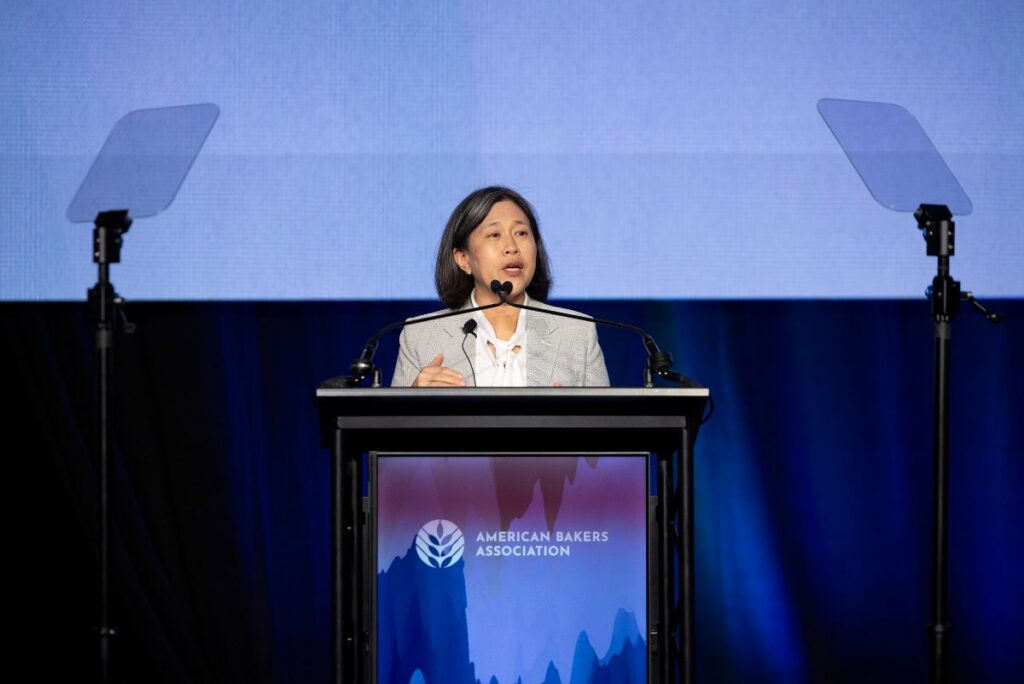
Katherine Tai presenting on navigating the 2026 trade landscape at the American Bakers Association's annual convention
PHOTO COURTESY OF AMERICAN BAKERS ASSOCIATION
BY: Maddie Lambert

Maddie Lambert

COLORADO SPRINGS, CO — Between the 1994 North American Free Trade Agreement (NAFTA) and the United States-Mexico-Canada Agreement (USMCA)’s ratification in 2020, the North American trade landscape has seen its fair share of evolution. As economic and geopolitical factors maintain their steady rate of being unsteady — impacting supply chains, tariff costs and upcoming trade policy reviews — commercial bakers may be questioning what the future looks like for their businesses.

Ambassador Katherine Tai, former US trade representative from 2021 to 2025, spoke to these concerns at the 2026 American Bakers Association (ABA)’s Annual Convention, held April 19-23 in Colorado Springs, CO.

Advertisement

To start, Tai acknowledged that the tariff actions and justifications under the current administration have been characterized by a high degree of unpredictability and volatility. The administration’s invocation of the International Emergency Economic Powers Act (IEEPA) imposed an estimated $173 million in tariffs, an effective tariff rate of about 7%.

“IEEPA and its related laws have served as the basis for US economic sanctions and export controls regimes that traditionally bring economic tools to bear in addressing national security concerns,” Tai said. “In February of last year, the current administration announced it would impose additional across-the-board tariffs of 25 percent on imports from Canada and Mexico and 10 percent additional on imports from China … The administration invoked IEEPA as the legal justification for these tariffs.”

However, after being challenged, the US Supreme Court declared IEEPA tariffs illegal, sparking a complex tariff refund process that is just now beginning to take shape through Customs and Border Protection.

Earlier this year, the administration pivoted to a different law: Section 122 of the Trade Act of 1974, a provision to address a US balance-of-payments deficit.

“Section 122 is now in place to support the application of 10 percent tariffs across the board to last 150 days, the statutory limit,” Tai explained. “While these Section 122 tariffs are being challenged in court again, the Office of the US Trade Representative rolled out 76 new investigations under yet another legal provision.”

“The key to not only navigating these next few years but also this next phase of international economic relations lies in resilience and adaptability.” — Katherine Tai | former US trade representative

Advertisement

These investigations will determine whether the policies and practices of 60 of the country’s major trading partners have harmed the US economy. Tai emphasized that, no matter the outcome, tariffs are here to stay.

Shedding light on USMCA, the second iteration of NAFTA, requires going back nine years, when the current administration initiated the renegotiation of what was then a 23-year-old foundational trade agreement for three North American countries. The deal enhances regional trade through strict rules of origin, stronger environmental standards, and introduces new digital trade provisions.

“One of the many innovations of the USMCA that sets it apart from other US free trade agreements is the fact that this agreement was designed to last only 16 years,” Tai said. “It was not created as a forever agreement. It lasts only for that amount of time, unless the three parties agree to extend the agreement.”

Advertisement

The trade agreement is currently preparing for a mandated six-year joint review starting July 1, amid rising trade tensions and US demands for concessions. Whether the USMCA continues, is extended, or becomes a series of bilateral agreements, the industry’s approach to supply chains and decision-making will remain affected.

However, there is light at the end of the tunnel.

“The key to navigating not only these next few years but also this next phase of international economic relations and this next version of globalization lies in resilience and adaptability,” Tai concluded. “If your collective values focus on the planet, workplace and community, then resilience and adaptability will take you very far.”

Related News

Advertisement

Advertisement

Advertisement

Advertisement

Popular Articles